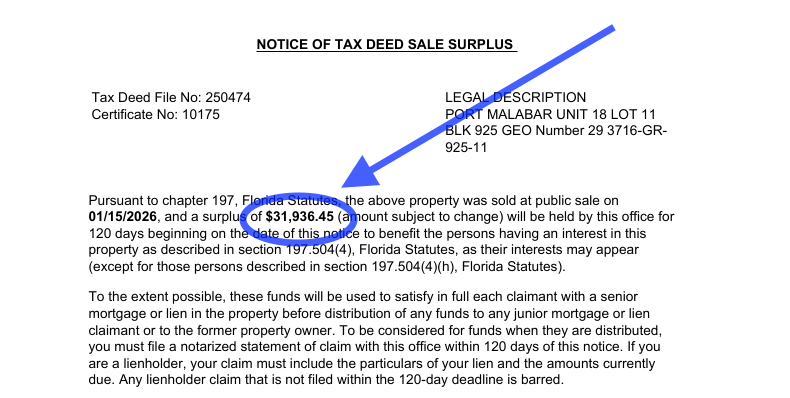
Provide a clear operational framework for understanding the mechanics of surplus capital and selecting your primary recovery niche. Focus on how understanding the distinction between tax and mortgage overages directly impacts your lead generation and closing timelines.
The Foundation of Your Venture
To succeed in asset recovery, you must internalize three core operational rules. First, your primary objective is facilitating the recovery of capital on behalf of your clients. Second, you need to transparently communicate that these assets were generated by a recent foreclosure event. Finally, you establish immediate credibility by operating entirely on a contingency basis, ensuring your clients never pay out-of-pocket expenses.
The Mechanics of a Surplus
What exactly is a surplus? It is the monetary difference left over when a property is liquidated at a foreclosure auction. The process is highly calculated. The local municipality or the lending institution establishes an opening bid. This baseline figure represents the exact debt owed by the property owner, such as back taxes or a final mortgage judgment. If third-party investors bid the property up and it sells for more than that initial debt, the remaining balance becomes the surplus.
Consider a practical scenario. Imagine a property owner falls behind and owes $12,000 in delinquent property taxes. The county initiates the auction with a starting bid of exactly $12,000. Because the property is highly desirable, a bidding war ensues, and it ultimately sells to an investor for $85,000. That single transaction creates a resulting surplus of $73,000.
Why does this money sit untouched? Local governments generally mail notifications to the primary address on file. In a foreclosure scenario, that address is inevitably the very property the individual was forced to vacate. Furthermore, counties often lack the financial motivation to track down these displaced individuals. If the capital remains unclaimed for a specific statutory period, the local government can sometimes legally absorb the funds into its own accounts.
Who is Entitled to the Capital?
Identifying the legal claimant is a critical phase of your due diligence. By law, several distinct parties may possess the right to claim these excess proceeds.
The primary claimant is usually the previous property owner.
Next of kin, such as a surviving spouse, children, or other direct relatives, can claim the funds if the original owner has passed away.
Creditors who held valid liens against the property prior to the sale are also eligible.
Government entities like the Internal Revenue Service may file a claim to recover unpaid obligations.
Corporate entities that previously held the title can be entitled to recovery.
It is important to note that any outstanding municipal debt, such as county fees for property upkeep, is automatically deducted by the county directly from the surplus before final disbursement.
Understanding the Industry Divide
The surplus funds industry is essentially split into two distinct sectors based on the type of foreclosure. Every successful recovery agency builds its foundation by mastering one of these sectors first.
Sector 1: Tax Deed Overages
When an owner defaults on their property taxes, the local municipality eventually initiates a foreclosure to recoup those losses. These funds are vital for maintaining public infrastructure like law enforcement and education. This event is known as a tax deed or tax lien auction.
The Strategic Advantage: Tax overages represent the most accessible entry point for a new recovery specialist. The data is managed directly by county governments. This means lists of surplus funds are often public record and straightforward to acquire. The claim process is standardized by state statutes. If you want a structured and predictable environment to build your initial systems, tax overages provide that stability.
Sector 2: Mortgage Foreclosure Overages
Conversely, mortgage overages stem from bank foreclosures. Often executed as sheriff sales, this happens when a borrower defaults on their loan or homeowners association dues. This prompts the lender to act as the plaintiff, legally seizing and liquidating the asset to recover their money.
The Operational Reality: Mortgage overages often yield significantly higher dollar amounts than tax overages. That higher yield naturally attracts aggressive competition. The data is held by third-party trustees or specialized law firms rather than public county clerks. Acquiring accurate lists requires advanced research capabilities and paid software tools. This sector is highly profitable but demands a higher level of operational sophistication.
Effort vs. Reward Analysis
Effort versus reward is a critical metric for an asset recovery specialist. You must constantly weigh the operational timeline against the projected financial payout. Not all leads are created equal. Understanding the distribution of time versus reward is crucial for scaling your surplus funds business efficiently. Standard tax deed sales offer high volume, while targeting specific niches like deceased owner estates yields massive payouts with a slightly longer closing timeline.
The Strategic Recommendation
How do you guarantee your first successful recovery? You eliminate unnecessary friction.
For new agencies utilizing the Surplus Launch blueprint, the directive is clear. Begin your operations exclusively within the tax overage sector. Master the county-level data. Refine your skip-tracing protocols. Secure your first signed contingency agreements in an environment with standardized rules.
Once you have built a predictable revenue stream and established a robust attorney network, you will possess the infrastructure required to compete in the mortgage overage space.
Your Next Action
Evaluate the resources you reviewed in Module 1. Identify three target states where you intend to source your initial tax overage leads. We will use these specific states as your operational foundation as we move into developing the recovery mindset.
Most organizations in this space hide their knowledge behind a paywall, charging hundreds or even thousands of dollars just to get started. We’ve chosen a different path.
The truth is, thousands of foreclosed property owners lose their equity every year simply because they don’t know it exists. We have a simple philosophy: the more people we train to recover these surplus funds, the more families we can reunite with their rightful money. It’s about impact, not entry fees.
If the training is free, how do we stay in business? Throughout our curriculum, we recommend specific affiliate services essential to your success. When you use these tools through our links, the providers pay us a small commission.
The best part? You are never charged a penny extra. You get the tools you need at the standard price, and those commissions allow us to keep this high-level training accessible to everyone. We win, you win, and, most importantly, the property owners win.
 Skip to content